
What is Locai? Architecting Sovereign, Off-Cloud AI Infrastructure for Regulated Enterprises
As organisations scale production-grade artificial intelligence, they inevitably hit a wall built of three compounding challenges: runaway public cloud compute costs, unpredictable latency spikes, and severe compliance liabilities. For regulated sectors operating under strict data protection frameworks, sending highly sensitive intellectual property or customer data to centralised third-party APIs is no longer a viable operational strategy.
Enter Locai (often searched as loc ai).
Locai provides the sovereign, off-cloud AI infrastructure required to run enterprise-grade machine learning models locally on distributed end-user devices, local servers, and private hardware. By shifting the computational burden of AI inference away from centralised cloud providers and directly onto local nodes, enterprises can eliminate data transit risks, slash operational expenditures, and guarantee absolute data sovereignty.
(Note: If you are searching for "loc ai" in reference to the United States Library of Congress and their research into artificial intelligence initiatives, please refer directly to their official digital innovation division. Locai is an independent, UK-based B2B private AI infrastructure provider serving enterprise engineering teams.)
What is Locai (LOCAI)?
At its core, Locai is a comprehensive private AI infrastructure platform designed for CTOs, VP Engineering, and Heads of Machine Learning who require complete control over their deployment environments.
Instead of routing user prompts through external cloud APIs, Locai enables organisations to package, distribute, and execute open-weight and proprietary machine learning models directly on localised hardware assets—such as enterprise laptops, workstations, on-premise servers, and edge devices.
       [ Public Cloud API Architecture ]
       User Device ---> [ Public Internet ] ---> [ Centralised Cloud API ] (Data Exposed)

       [ Locai Sovereign Architecture ]
       User Device [ Locai Runtime + Local Model + Local Hardware ] (Zero Data Transit)
The platform acts as a bridge between high-performance machine learning models and distributed local silicon. It consists of an optimised off-cloud inference runtime, an orchestration control plane, and a centralised model registry. Together, these components allow developers to manage a fleet of localised AI nodes with the same ease of use, deployment speed, and reliability typically associated with centralised cloud platforms.
The Sovereign AI Advantage: Resolving Public Cloud Vulnerabilities
Relying on the public cloud for machine learning workloads introduces significant, systemic vulnerabilities for modern enterprises:
- The Sovereignty Gap: When prompts and internal corporate documents are sent to external cloud APIs, organisations lose custody of their data. For entities operating under GDPR, HIPAA, or strict financial regulations in the UK and Europe, this data exposure represents an immediate compliance failure.
- Exploding and Unpredictable Costs: Cloud compute pricing is highly volatile. Pay-as-you-go API consumption models punish business growth; as your user base or query volume scales, your monthly cloud bill escalates exponentially without generating corresponding infrastructure assets.
- Latency and Outage Risks: Relying on a round-trip connection to a centralised cloud data centre introduces unavoidable latency overhead. Furthermore, if the cloud provider experiences an outage, your core product's AI capabilities instantly go offline.
Locai resolves these vulnerabilities by establishing a local-first architecture. By executing inference locally on the end-user's physical machine or inside a closed enterprise network, data never leaves the security boundary of the device. This approach keeps prompts, model weights, and outputs strictly under local control, ensuring total privacy while insulating the organisation from public cloud outages and bandwidth constraints.
Inside the Locai Product Ecosystem
Locai replaces the complexity of traditional local machine learning deployments with a streamlined, production-ready product ecosystem.
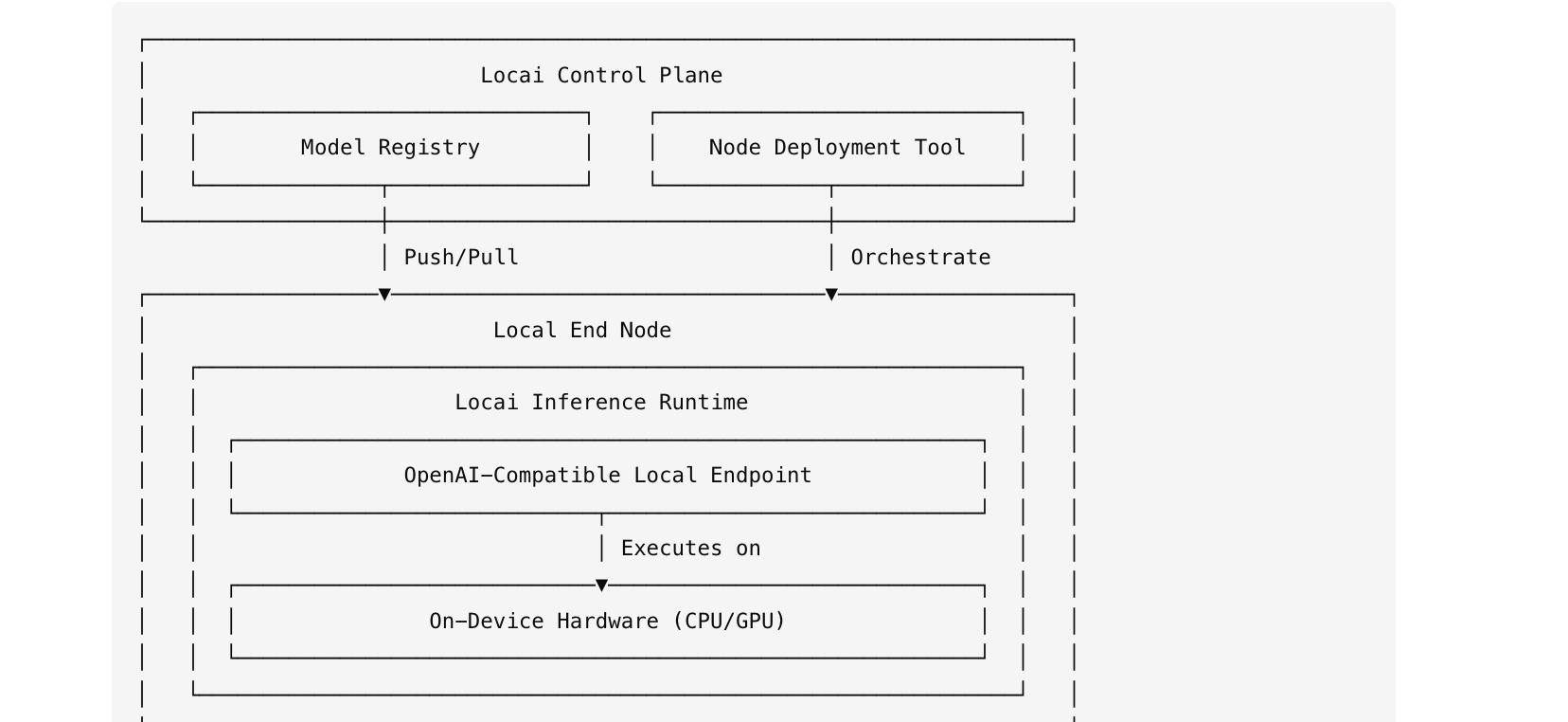
Local Inference Runtime & OpenAI-Compatible Endpoint
The core engine of the platform is the Locai Inference Runtime, a highly optimised, low-footprint execution engine designed for local hardware (ranging from Apple Silicon to enterprise NVIDIA GPUs).
To eliminate migration friction, the runtime exposes an OpenAI-compatible local endpoint. For engineering teams, migrating from OpenAI or other proprietary cloud APIs to a completely private, on-device model requires changing only two lines of code:
# Before: Public Cloud API
# import openai
# client = openai.OpenAI(api_key="sk-public-cloud-key")

# After: Sovereign Local Inference with Locai
import openai
client = openai.OpenAI(
    base_url="http://localhost:8080/v1", # Locai local endpoint
    api_key="locai-local-sovereign-key"
)
This drop-in replacement architecture allows developers to swap out public cloud endpoints instantly, maintaining their existing codebases, SDKs, and application logic while moving 100% of the actual computation off-cloud.
Distributed Node Control Plane & Model Registry
Managing machine learning models across hundreds or thousands of distributed user workstations or local servers can quickly become an operational nightmare. Locai solves this with its enterprise Control Plane and Model Registry:
- Model Registry: A secure repository where ML teams can store, version, and license fine-tuned models. Secure weights are cryptographically verified and packaged for deployment.
- Node Deployment Tooling: Allows administrators to orchestrate and push model updates silently to remote end nodes. This ensures that every local device runs the correct model version and configuration without requiring manual end-user intervention.
How Locai Compares to Alternative Platforms
When designing local or sovereign AI architectures, engineering leaders evaluate several approaches. The table below outlines how Locai compares across key enterprise requirements against other prominent options in the machine learning ecosystem.
| Capability / Feature | Locai | Hugging Face | OctoML | NVIDIA Inference Stack |
|---|---|---|---|---|
| Primary Deployment Focus | Sovereign, off-cloud, and on-device runtimes | Centralised model repository & cloud hosting | Cloud-centric model optimisation & hosting | Low-level GPU acceleration & SDKs |
| Data Privacy & Residency | Absolute. Local-first execution; zero data transit. | Variable. Depends on third-party cloud hosting. | Variable. Models run in managed cloud containers. | Absolute when deployed on-premise. |
| Control Plane Orchestration | Included. Distributes models and runs updates across remote nodes. | None. Relies on external CI/CD or cloud APIs. | None. Focuses on cloud-hosted endpoints. | Manual. Requires Kubernetes/Triton engineering. |
| Developer API Migration | Drop-in. OpenAI-compatible local API wrapper. | Custom APIs. Requires integration code rewriting. | Custom APIs. Requires integration code rewriting. | Low-level. Requires extensive integration engineering. |
| Pricing Predictability | Fixed Tiers. Predictable, non-consumption pricing. | Pay-as-you-go or tier-based cloud hosting. | Pay-as-you-go usage metrics. | Capital expenditure on physical hardware. |
Locai vs. Hugging Face
Hugging Face is an invaluable ecosystem and registry for open-weight models. However, Hugging Face primarily functions as a centralised repository and a platform for cloud-hosted spaces. It does not provide the edge-orchestrated control plane or local runtime optimisation required to deploy, update, and secure those models locally across thousands of distributed corporate devices. Locai acts as a downstream deployment companion to Hugging Face: developers pull open-weight models from Hugging Face, optimise them, and use the Locai registry to securely push them to local end nodes.
Locai vs. OctoML
OctoML (now focused on core acceleration technologies) historically designed its platform around compiling and optimising models for centralised cloud execution. Locai takes the opposite structural approach: we optimise models specifically for heterogeneous, off-cloud, on-device runtimes, ensuring that performance is maximised on consumer-grade and enterprise local hardware rather than scaling up expensive cloud VM instances.
Locai vs. NVIDIA Inference Stack
The NVIDIA inference stack (including TensorRT and Triton Inference Server) represents the gold standard for raw hardware performance. Locai does not compete with NVIDIA; rather, we are deeply integrated with their ecosystem as members of the NVIDIA Inception Program. While Triton and TensorRT provide the deep hardware abstraction layer, Locai provides the higher-level application control plane, the OpenAI-compatible developer interface, and the distributed node orchestration needed to manage those workloads across an entire corporate fleet.
Enterprise Trust, Compliance, and UK Legal Jurisdiction
For UK and European enterprises, sovereign data protection is not merely a technical preference—it is a legal mandate.
Based in the United Kingdom, Locai operates entirely under UK legal jurisdiction. This provides European customers with a critical layer of structural compliance protection:
- GDPR & HIPAA Compliance by Design: Because the Locai runtime processes all conversational data, prompts, and training weights locally on your own physical hardware, there is no international data transfer. Your data remains protected from foreign cloud surveillance acts (such as the US CLOUD Act) and strictly adheres to local data residency laws.
- Corporate Auditable Security: Enterprise security teams can completely audit the local runtime, ensuring that no outbound telemetry containing sensitive corporate inputs or personal identifiable information (PII) is ever transmitted back to external servers.
- Predictable, Single-Jurisdiction Contracts: Operating within the UK legal framework simplifies vendor risk assessments and procurement processes for financial services, healthcare authorities, and defence contractors.
Calculating the Economics: Public Cloud Fees vs. Fixed Off-Cloud Pricing
Beyond data security, the ultimate validation of an off-cloud architecture lies in its unit economics.
Consider a financial services firm employing 2,000 analysts, each interacting with an AI assistant throughout the workday. Under a standard centralised cloud model, the organisation pays per token processed:
Monthly Cost = Number of Users × (Tokens per day / User) × Days × Cost per TokenAt scale, this variable consumption model results in highly volatile, monthly operational expenses that increase linearly with business activity.
By contrast, Locai shifts your cost structure from variable operational expenses to a predictable, fixed-tier subscription. Because the actual computation is performed using the silicon already sitting inside your company's existing hardware assets (such as employee laptops and local workstation GPUs), your incremental cost per token is precisely zero.
By leveraging your existing hardware footprint, Locai helps organisations reduce their total cost of ownership (TCO) for AI deployments by up to 80% compared to equivalent public cloud APIs. To see how these economics apply to your specific deployment footprint, explore the Locai Cost Savings & Unit Economics Calculator.