
KEY TAKEAWAYS:
-
71% of employees use unapproved AI tools at work — shadow AI is already inside your organisation
-
Banning ChatGPT doesn’t stop shadow AI; it makes it untraceable
-
Sovereign AI means inference runs inside your own environment — not on a foreign hyperscaler’s servers
-
Private cloud and DIY on-prem both fail regulated firms for different reasons
-
On-device AI handles most enterprise tasks without data ever leaving the user’s machine
-
SafeChat by Locai is a sovereign AI workspace that works like ChatGPT — browser-based, zero install, compliant by default.
Why regulated organisations already have a shadow AI problem
Sovereign AI for regulated organisations starts with an uncomfortable fact: your employees are already using AI, whether your organisation has sanctioned it or not. According to Microsoft’s 2025 Work Trend Index, 71% of workers use unapproved AI tools at work, and LayerX research puts the share pasting corporate data into public chatbots at 77%. IBM’s Cost of a Data Breach 2025 report found that one in five organisations had a breach with shadow AI as the entry point.
These aren’t negligent employees making careless decisions. They’re the people doing the actual work — analysts, project managers, operations leads — who found a tool that meaningfully improves their output and were never offered a sanctioned equivalent.
Why does banning ChatGPT fail to solve the shadow AI problem?
Writing a stricter policy is the natural first response — restrict access, issue guidance, remind staff of their obligations. It doesn’t hold. Shadow AI use persists because the underlying need doesn’t go away when the tool gets blocked; it just moves somewhere less visible. IDC’s 2025 research found 56% of employees use unauthorised AI tools while only 23% use tools their employer actually governs. That 33-point gap reflects a provision failure, not a compliance one. Until there’s a sanctioned alternative worth using, the gap stays open.
What does sovereign AI actually mean at the organisational level?
Sovereign AI has been a national-level conversation — governments investing in domestic compute, data residency policy, digital independence from foreign hyperscalers. BT, NVIDIA, and Nscale announced plans in April 2026 to build sovereign AI data centres enabling UK organisations to “adopt AI securely, at scale, and under UK control.” That same principle now applies inside individual organisations.
For a regulated firm, sovereign AI means AI inference runs inside your own environment. Prompts never cross your firewall. The auditor asks where your AI data goes and the answer is: nowhere. It stays on your servers — or on your users’ devices.
This is the shift from “we use cloud AI” to “we own where our AI runs.”
What are the options for sovereign AI in a regulated enterprise?
When regulated firms evaluate alternatives to ChatGPT, the conversation usually lands on one of four paths. Each fails differently.
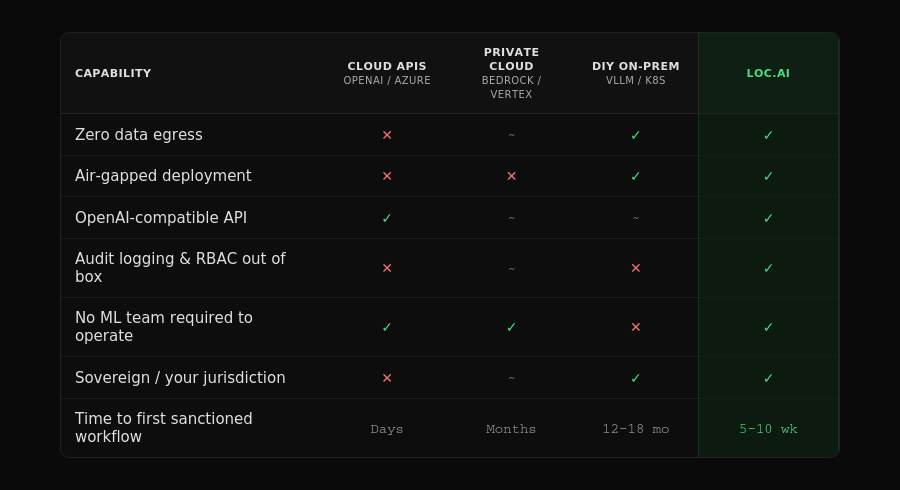
AWS Bedrock and Google Vertex position themselves as the compliant middle ground between public cloud and full on-premises. In practice, your data still transits infrastructure that a foreign hyperscaler owns and operates, governed by their terms and their jurisdiction. For organisations under GDPR, FCA rules, or sector-specific data residency obligations, that’s not a meaningful distinction from the auditor’s perspective.
Building on-premises with open-source tooling — vLLM, TGI, Kubernetes — does give you genuine data sovereignty. The barrier isn’t technical feasibility; it’s the resource cost. You need to procure hardware, build a serving layer, implement governance, audit logging, role-based access, model versioning, and fallback logic, then maintain all of it indefinitely. Most regulated firms that attempt this path either run out of runway before they reach production or quietly deprioritise it when quarterly pressures arrive.
On-device inference is the fourth option and the least understood. The historical barrier wasn’t capability — it was the absence of infrastructure to manage and orchestrate models across a fleet of different user devices at scale. That infrastructure now exists.
Can on-device AI models handle real enterprise workloads?
Most enterprise AI evaluations assume only frontier cloud models are capable enough to trust with real work. That assumption is increasingly wrong.
The majority of workplace AI tasks — summarising a document, pulling key clauses from a contract, answering questions about internal policy, drafting a compliance summary — are well within the capability range of models in the 7-13 billion parameter class running locally. These aren’t approximations of frontier model output for simple tasks; they’re appropriate tools for the job. The performance difference between a well-configured local model and a GPT-4-class API call is significant for complex, multi-step reasoning. For the routine work that makes up most of an organisation’s actual AI usage, the gap is far smaller than procurement teams typically assume — and it narrows further every quarter.
Sovereign AI infrastructure that runs locally isn’t a compromise. For most enterprise use cases, it’s the right architecture.
How does SafeChat work as a sovereign AI alternative to ChatGPT?
SafeChat is built by Locai — a device-first AI infrastructure company backed by Google for Startups, NVIDIA Inception, and Fuel Ventures. It runs like ChatGPT from the user’s perspective — open a browser, sign in, start working — but the model runs on the user’s own machine. Nothing typed into SafeChat is transmitted anywhere. Locai handles authentication and model metadata only; the content of every conversation stays local.
For devices that need more compute than they carry, SafeChat routes to your own servers or a cloud endpoint your organisation controls — not a third-party API. The sovereignty guarantee applies regardless of which compute mode runs the inference. Architected for SOC2, GDPR, and HIPAA compliance. Compliant by default, not by configuration.
SafeChat is open for early access now for teams in financial services, healthcare, legal, and other regulated environments.
→ Request early access · How Locai infrastructure for Enterprise works
Frequently asked questions about sovereign AI for enterprises
What is shadow AI in an organisation? Shadow AI refers to AI tools employees use at work without their organisation’s knowledge or approval — typically consumer products like ChatGPT or Copilot. According to IBM’s 2025 Cost of a Data Breach report, 1 in 5 organisations experienced a breach via shadow AI in the last twelve months, with an additional $670K in average breach costs when shadow AI was the vector.
What is the difference between private AI and sovereign AI?
Private AI typically means AI that doesn’t share your data with third parties. Sovereign AI is more specific: it means AI that runs under your own governance, in your own jurisdiction, on infrastructure you control. A private cloud still runs on someone else’s servers. Sovereign AI runs on yours — or on your users’ own devices.
Why doesn’t private cloud AI satisfy regulated industries?
Private cloud platforms like AWS Bedrock and Google Vertex offer dedicated compute, but your data still moves through infrastructure owned and operated by a foreign hyperscaler. For organisations subject to GDPR, FCA, HIPAA, or data residency requirements, “dedicated tenancy” doesn’t mean the data stays in your jurisdiction or under your audit trail.
How long does it take to deploy sovereign AI in a regulated enterprise?
DIY on-premises deployment typically takes 12-18 months before the first production workflow. Locai’s on-device approach — using SafeChat — gets regulated teams from sign-up to first sanctioned workflow in days, with no IT project required. A full enterprise rollout including security review and pilot typically runs 5-10 weeks.
Is on-device AI good enough for enterprise use cases?
For most common workplace tasks — document summarisation, internal Q&A, contract review, compliance drafting — yes. Modern 7-13 billion parameter models running locally handle these tasks without GPT-4-scale compute. The performance gap versus frontier cloud models is real for complex reasoning tasks; for routine work it is narrower than most procurement teams currently assume.
What compliance certifications does SafeChat have?
Architected for SOC2, GDPR, and HIPAA compliance. SOC2 in progress. SafeChat is compliant by default — conversation and document content are never transmitted, Locai handles authentication and model metadata only, and the system supports fully air-gapped deployments for environments where no internet connection is permitted.
What is on-device AI inference?
On-device AI inference means the AI model runs directly on the user’s own hardware — their laptop, workstation, or local server — rather than sending data to a remote cloud server for processing. No prompt leaves the device. Response latency drops to near-zero compared to 300-800ms cloud round-trips, and data sovereignty is maintained by architecture rather than by policy.